








Conversations about making CI a reality
Recently active
In 2022, Customer Intelligence emerged as a new business solution category, one that helps companies become more customer-centric and double down on revenue from their existing customer base. The momentum of the Customer Intelligence movement has been exciting to say the least!How can 2023 compare, you ask? I believe we have only seen the beginning of the impact customer data and insights can have on business transformation and customer value!Here are my top predictions for how customers will continue to be the greatest lever for revenue growth and ultimate success…especially in a questionable economy! Prediction #1: Customer health scoring will be defined by data-driven, personalized customer outcome measuresHealth scoring has been a huge component of Customer Success leadership over the years. It has helped us track customers’ wellbeing, identify customers who need additional support, and lend assistance to CSMs guiding customers through challenges. But with today’s technology, relyi
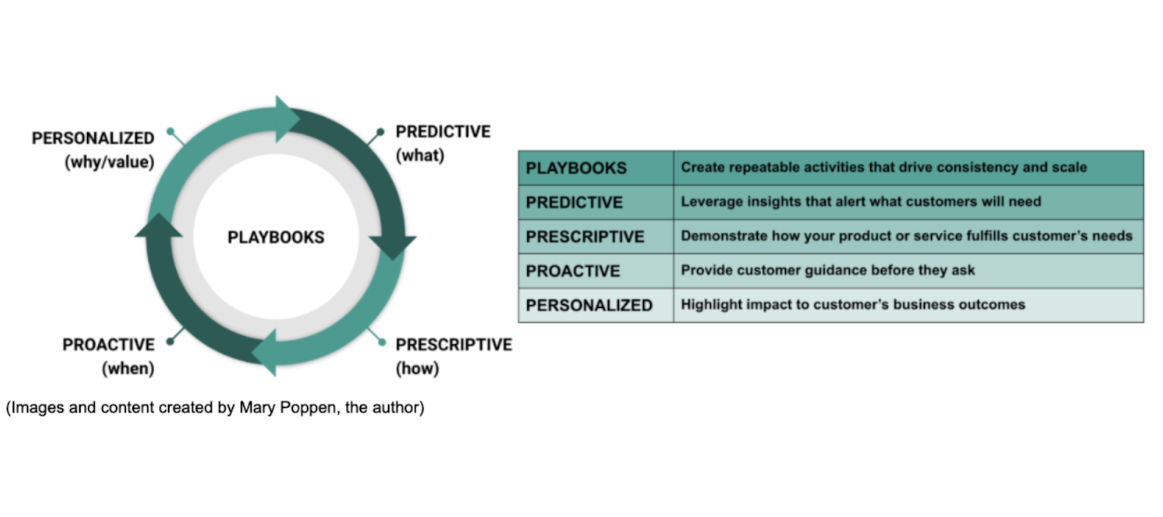
The 5 P’s FrameworkI recently published a book about the evolution of Customer Intelligence: Goodbye Churn. Hello Growth! In it, I introduced a framework I created to help me implement Customer Intelligence at a prior company: The 5 P’s. This set of concepts is a way of aligning people, processes and technology, and I wanted to share with this community of leaders on the journey toward Customer Intelligence. I’d love to hear what frameworks others of you are using in your own programs! What are the 5 P’s and how do they work togetherThe image above really sums up the 5 P’s structure and purpose. Each P is only meaningful in combination with and in support of the others.PlaybooksCustomer teams rely on Playbooks - repeatable activities that drive consistency and scale. These are typically crafted in categories: what to do in the case of an at-risk customer, what to do in the case of an upcoming renewal, etc. In the era of Customer Intelligence, we can craft our playbooks to be much more
Hello CI.ty! I’m one of the involve.ai co-founders and our Chief Product Officer. I've had such a great response to my recent webinar on Gut Instinct vs Data that I've been working with our Marketing team to develop a daily series on the topic. I'll be sharing learnings on what drives net revenue retention, what to look for, and the risks of using intuition over being data-driven.Post in the comments here if there are myths you want to see us address or that your own team has busted with data! I know many of you have uncovered surprises. In the meantime, here’s... Myth #1: NPS is all you need.Net Promoter Score is broken. Don’t you agree?! “NPS can never be the only driver of churn; it should always exist in combination with other data elements.” Myth #2: Support cases = bad.Leaders should LOVE high support tickets. It’s true! We should! Support tickets may mean users are engaged and eager to succeed with your product. When support tickets indicate a problem is when the support
Hi Customer Intelligence Community, I'm Eric Grunden, the CCO for MatrixCare, part of ResMed. A few weeks ago, I participated in a panel with involve.ai's Mary Poppen and WalkMe's Wayne McColluch, and while our conversation centered around the role of CS in shifting markets, we veered into some very human topics, near and dear to my heart. I wanted to share some of those thoughts here - the way CS, data, and empathy interact - and the story behind my perspective.We often, and rightfully, focus on Customer Intelligence as a means of revenue retention. But we risk forgetting that it also runs deeper than that. Good CI gives us, as leaders and organizations, a path to be more human. It allows our teams to be heroes and to build meaningful relationships with customers most in need of support. “We do not lose a customer during this time”My company experienced this firsthand during the last economic downturn, in the early days of the pandemic. As an Electronic Health Records software for pos
At one of my prior companies, before the magic of automated health scoring, I asked the CSMs on my team to manually input and track customer health in our CRM. We prescribed ranges and color coding to keep things as simple as possible.What do you think happened?Miraculously, almost all of our customers displayed as if they were in great health. Our health score column was a flood of green, high, renewable scores.Aaand we watched some of these green, healthy customers churn.Of course, this high health across the board was an illusion. Not only were our team members coming from various subjective perspectives, they were also worried that highlighting at-risk customers would reflect poorly on them. So red customers were marked yellow, yellow customers green. In a society where we’ve been socialized by report cards from a young age, this makes perfect sense: seeing the health of one’s complex customer boiled down to a single number can feel like a reflection on one’s work in a customer-fac
If mitigating churn is a top priority for your organization, you’re in good company. And for good reason! Churn costs organizations billions of dollars annually. But with the power of AI and a burgeoning understanding of Customer Intelligence (CI), we can do more than simply reduce churn – we can crush it! Let’s consider a few of the most effective ways… Focus on customer value.Reduce churn: Customers churn because of a lack of perceived value - they can easily see their spend and resource costs, but not always the positive outcomes of your products or services. CS leaders have long understood the importance of making sure customers both get and recognize the most possible value from products or services. Now crush it! CI lets us take this a step further by using data to see exactly where customers’ recognition of perceived value is waning, what products, features or services they are failing to optimize, and where you can provide more personalized support. Listen activelyReduce churn
I had the pleasure recently of speaking on a webinar about the transition from bull to bear market and, in particular, how to be data-driven in the approach. As co-founder of a growing company focused on both our people and the analysis of data, I am of course thinking about these topics incessantly, as are, I’m sure, many of you. So I wanted to share my two cents here, and open a discussion about how (if?) others in Customer Success are letting data be their guide. Our team’s approach to market volatility is layering our North Star strategy - trusting data vs intuition - across two important focus areas: Customer-centricity and efficiency.While these are focus areas our team always encourages, they ring especially true in times of market uncertainty, when nurturing existing customers is essential, and doing more with less is imperative. Some ways data can help us nurture customers, and do more with limited teams and budgetsDetect unhappy customers early, so that we can be proactive,
With the vast amount of data at our fingertips, it’s tempting to measure everything. Because of this, many organizations suffer from a ‘more is better’ mentality. Organizations want to capture everything to make sure that they’re not missing anything. But, in doing so, they end up seeing noise and no signal!When building an impactful customer data model, keep these 3 things top of mind: Not all data is important Not all data drives insights Not all data that matters to you matters to your customers The most important consideration when selecting metrics for your data model are their actionable properties; can your team actually do something about this data? If not, it may just be a vanity metric. If you fall into the trap of including everything and anything, you’re inadvertently overwhelming your CSMs with data that they can’t do anything about and that may end up distracting them from directionally relevant data that will actually help them reduce churn and drive more value for
There’s both good and bad news when it comes to data today. The good news is that today’s technology gives us access to unprecedented amounts of customer data. The bad news is that we’re not all utilizing that data to deliver the best possible outcomes for our companies. Many businesses use customer data incorrectly. Others have incomplete data, prohibiting them from taking the necessary actions that would actually change customer conversations. The Challenge of DataCollecting and utilizing the right data can be challenging on several levels:How do you aggregate the right customer data? How do you get the insights that drive better customer conversations? Does the data tell you about the strength and the health of your customer relationships? As a Customer Success professional, can you do something with the data to change the trajectory of your customer relationships? How can you use the data to create excellent customer experiences so that when renewal time comes around, you are in
Hello CI.ty members! I’m the Chief Strategy & Customer Officer at involve.ai, and would love to connect about the various ways we've all become interested in the Customer Intelligence movement. My own journey toward CI...My interest in Customer Intelligence started years ago, but I didn’t have a name for it. I was the CCO at Glint, now part of Microsoft and LinkedIn, and our CS team was exceptional. But as our customer base grew, so did the feeling that we weren’t using available information to its fullest in our quest for customer intimacy.We were investing in terrific platforms -- Gainsight, Zendesk, Skilljar and inSided, and of course our own product -- and each delivered mountains of data. But even with a CS Ops team, we didn’t have the capacity to identify insights and take action holistically; any data analysis was very manual and time-consuming. We had other things we needed to get done; halting to analyze the data (which would quickly become outdated) felt futile. When I f
An interesting article that crossed my path today by Tammi Warfield, Chief Customer Officer of Delphix in Customer Think.Tammi says "best CSMs were the ones who possessed a high degree of empathy and an intense desire to help customers find value. Their success was so closely tied to their customer’s success that it was hard to separate the two."I really liked what Tammi says about women sales leaders: "Women-led sales teams deliver higher win and quota attainment rates than their male counterparts."Definitely a great read. Highly recommended https://customerthink.com/why-customer-success-and-women-are-the-future-of-sales/
This was a great read this Saturday morning. Takeaway, increase the touch points along the entire journey. What is your take? "This strategy requires B2B companies that have adopted customer success (CS) technology to transition their CS programs from solely focusing on initial interactions and end experiences to a new model that consistently optimizes the entire customer journey.""The secrets to Apple and Tesla’s customer success are finally attainable for B2B businesses | VentureBeat" https://venturebeat.com/2022/05/06/the-secrets-to-apple-and-teslas-customer-success-are-finally-attainable-for-b2b-businesses/amp/
Thought the community may enjoy reading this post by Jeanne Bliss on questions to ask when interviewing for a Chief Customer Officer position. https://www.customerbliss.com/8-questions-to-ask-when-interviewing-for-a-chief-customer-officer-position/
Most business functions have historically had access to customer information. Many are now taking the next step: Customer Intelligence (CI). CI takes customer information to the next level, using it to uncover insight about customers’ behaviors. How does CI help different roles?As per the recently published involve.ai white paper, What is Customer Intelligence?, CI has long been integral to Marketing and Finance teams, supporting targeted, relevant campaigns and predicting ROI of particular initiatives.However, as subscription services and SaaS have become a dominant business model, and as technology like involve.ai has become capable of delivering quick, accurate insights, CI is quickly becoming not just relevant, but essential to virtually all functions. Revenue / Ops - A deep, predictive knowledge of customers’ behavior, allows this team to prepare for or raise alerts about changes to Annual Recurring Revenue (ARR). Office of the CEO - Corporate executives are responsible for holi
Already have an account? Login
No account yet? Create an account
Enter your E-mail address. We'll send you an e-mail with instructions to reset your password.